HEART PROMPT – OCT. 30
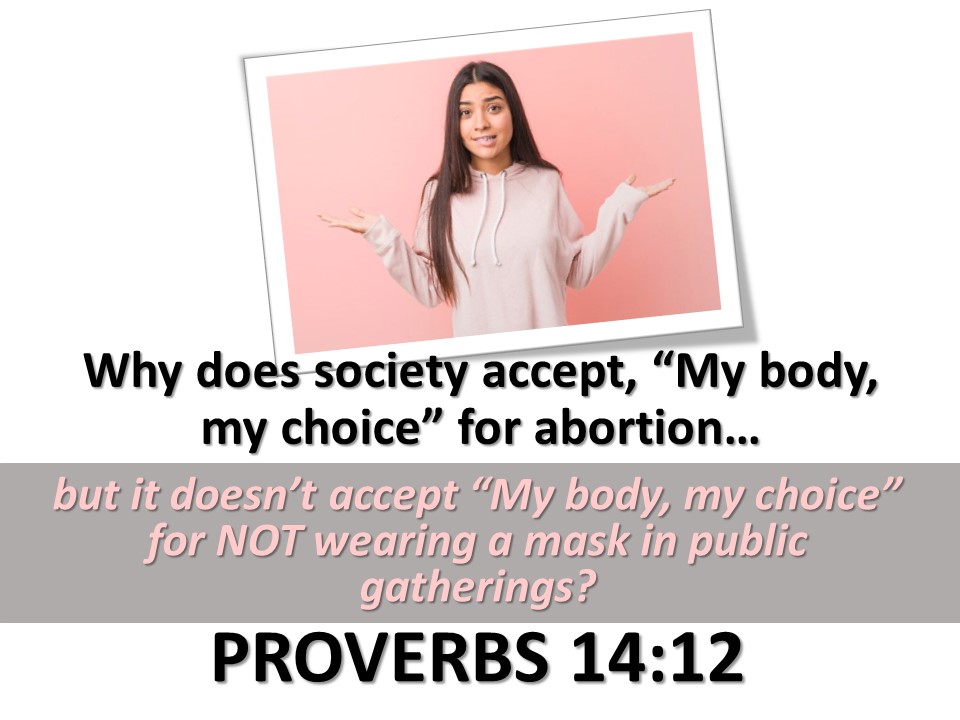

Some people promote and tout abortion as a “right”. . .
Even though the decision to have an abortion has fatal consequences for the infant, and possibly dire consequences for the mother, a women who chooses that path many times uses the argument that it’s her body, so it is her choice.
Even though the infant within her is not her body, still she proclaims, ” My body; my choice!”, and even though the decision affects the infant within her, her cry is still the same, “My body, My choice!”
Now forward to 2020.
The COVID virus has been among us for months.
Many say that by wearing masks, perhaps others will be spared from catching the malady.
Some refuse to wear the masks.
They say they shouldn’t have to if they choose not to – “My body, My choice!”
But others insist they MUST wear the mask, because to not do so may affect others and authorities require masks be worn.
They ironically reject the “my body, my choice” argument.
They insist that the refusal to wear a mask is not a choice that should be allowed to be made.
The astonishing thing is that many of those who seek to remove the right to choose to remove a mask because it affects others, are the same ones who who argue that an abortion is a right, despite the consequences to others!
Joe Dukes
“My body, My choice” cannot be used as an argument for abortion, an act that results in certain death, and then refused as an argument for something with much less certain consequences. Joe Dukes, edited
“I call heaven and earth as witnesses today against you, that I have set before you life and death, blessing and cursing; therefore choose life, that both you and your descendants may live” (Deut. 30:19; Psm. 139:14-16).
Joe is a member of the Oxford church of Christ, Oxford, AL, and lives near Pell City.
“God loves you and I love you and that’s the way it’s gonna be!” – Mike

If anything positive came out of that “sinful period” (2 Samuel 11) in David’s life, it was Psalm 51. . .
The king had separated himself from God, he was lonely, guilt-ridden, tormented by conscience and filled with fear.
He he had given in to lust, committed adultery, engaged in deception, and murdered Bathsheba’s husband, Uriah.
Following Nathan’s indictment and rebuke (2 Samuel 11:1-12), as well as his own initial expression of guilt and sorrow (2 Samuel 11:13), David penned what is considered by many to be the most heart-searching of the penitential psalms.
It is his lament — a sort of self-diagnosis of his own spiritual affliction, as well as a desperate cry for relief.
1. Notice WHERE HE WENT — to God (vv. 1-4) (a) For mercy — “according to the multitude of Your tender mercies” denoted the vastness of the Father’s loving kindness (v. 1); (b) For cleansing — words like “blot out,” “wash,” and “cleanse,” suggested David’s desire for his soul to be washed as filthy garments might be laundered (v. 2); (c) With confession — he had tried to force his sins out of his memory, but they tortured him … “my sin is ever before me.” Therefore, it was necessary that he articulate them to God (v. 4); (d) In faith — while he realized that he would inevitably give an account for his misdeeds, David trusted in God’s perfect righteousness (v. 4).
When we suffer with transgression, iniquity, and sin-sickness (vv. 1-3), we too, like David, must go to God, for none other can grant us healing except Him (cf. Psalm 30:2; 107:2; Jeremiah 33:6; Malachi 4:2; Mark 2:17).
2. Notice HOW HE FELT — sickly (vv. 6-9). David felt overwhelmed by his sins, having been conceived in a sinful environment (v. 5; cf. Matthew 19:14). He felt like he had been living a lie (v. 6), dirty (v. 7; cf. Matthew 23:27-28), sad and broken (v. 8), and guilty of perverting the right (v. 9). David felt spiritually ill and he couldn’t sleep until he started taking the Great Physician’s prescription.
Wrongdoing also ought to torment our consciences and make us restless until we have made things right with heaven (cf. 2 Corinthians 7: 10; 1 Peter 3:21). We can’t get better until we first recognize that we’re ailing.
3. Notice WHAT HE LONGED FOR — wholeness (vv. 10-14). David desired a fresh start — cleansing and renewal (v.10), intimacy as well as the Holy Spirit’s presence (v.11), restoration (v. 12), and deliverance (v. 14).
There is nothing quite as painful as being estranged from someone you love because of your own sin. But there’s also nothing that can compare with the joy and elation that comes with knowing you’ve been pardoned. David desperately yearned for pardon. Do you (cf. Luke 15:17-19) want to be made well, too (cf. John 5:6)?
4. Notice WHAT HE RESOLVED TO DO — repent (vv. 13-17). David promised to convert sinners (v. 13). He hoped that his own restoration would, in turn, direct other sinful lives toward God. He promised to sing praise (vv. 14-15). When God removed the burden and guilt of sin, David’s heart was filled with a joy which could not be contained. He also promised to offer the self-sacrifice of a broken and contrite heart (vv. 16-17).
All of the office visits in the world won’t do any good until we agree to abide by the Doctor’s counsel. There must be a legitimate change (cf. Acts 8:22) of our behavior if we are to enjoy good health. Do you dear brother/sister, like David, desire relief from the malady (Romans 6:23) of sin (2 Samuel 12:12)?
Please seek it.
Then receive it.
Then remember. . .if God forgave you, you – like David, can forgive yourself.
“God loves you and I love you and that’s the way it’s gonna be!” – Mike
 INCARNATE